France, 1981
TGV Sud-Est: The Orange Train That Brought Cities Closer
 ▶ Play timeline ▶ Watch on YouTube ↗
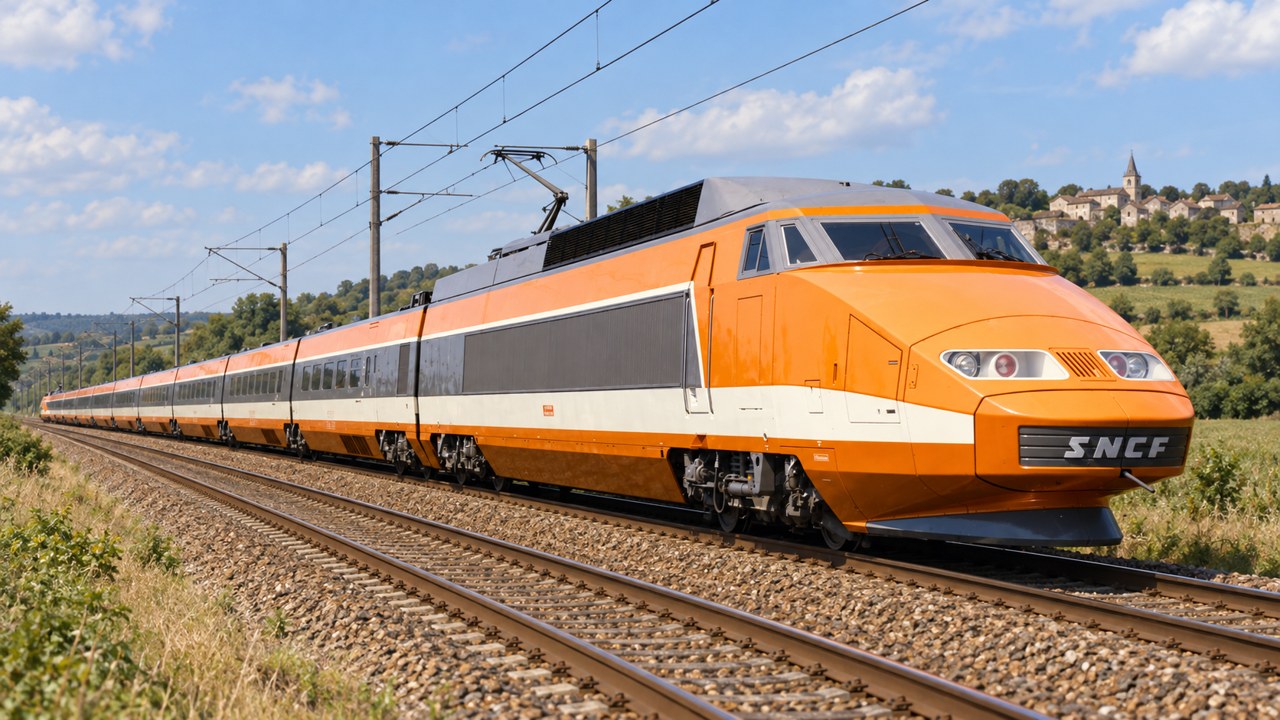
On 27 September 1981, passengers travelling between Paris and Lyon began using an orange train capable of reaching 260 kilometres per hour. Its name, TGV, stood for Train à Grande Vitesse: high-speed train. Those three letters would become shorthand for a new way of travelling across France.
Reaching that point required more than a powerful locomotive. The programme first explored gas turbines through TGV 001, a rolling laboratory used to investigate high-speed running. The 1973 oil crisis reinforced the move towards electric traction. The Sud-Est trains that entered service drew their energy from overhead wires.
Designer Jacques Cooper shaped their distinctive appearance. The long nose, flowing profile and strong orange colour made the new train recognisable from a distance. Its appearance accompanied a practical transformation: high speed was becoming a feature of a journey that passengers could book.
A trainset combined two power cars with eight passenger coaches. The coaches were articulated, with neighbouring vehicles sharing a bogie at their connection. This reduced the number of wheel assemblies and helped keep the bodies low. The train was conceived as an integrated unit rather than a collection of interchangeable vehicles.
The route supplied the other half of the innovation. A new line allowed the trains to exploit their speed, while connections to the conventional network brought them into existing stations. High-speed travel could reach the city without requiring an entirely separate terminal.
Driving changed as well. The signalling system delivered information to the driver inside the cab. At these speeds, the track, electrical supply and operating instructions were all parts of the same solution.
The new line opened in stages. It was already transforming Paris-Lyon travel in 1981; completion in 1983 brought the journey down to around two hours. That figure could change the shape of a passenger's day, making a distant destination much easier to reach.
Some Sud-Est sets later received upgrades that increased their performance. New generations and colour schemes followed, but orange remained associated with the beginning of the story. Cité du Train preserves vehicles from set 61 as a reminder of that era.
The Sud-Est's legacy lies in the combination of train, infrastructure and service. Its shape caught the eye; the ability to deliver a fast journey again and again changed the relationship between cities.