Japan · 1964
Series 0 Shinkansen: A New Measure of Time
 ▶ Play timeline ▶ Watch on YouTube ↗
What changes when two cities become several hours closer? Travel can take up less of the day, opening different ways to plan a visit, a meeting or a holiday. The Shinkansen made that question tangible for Japanese passengers.
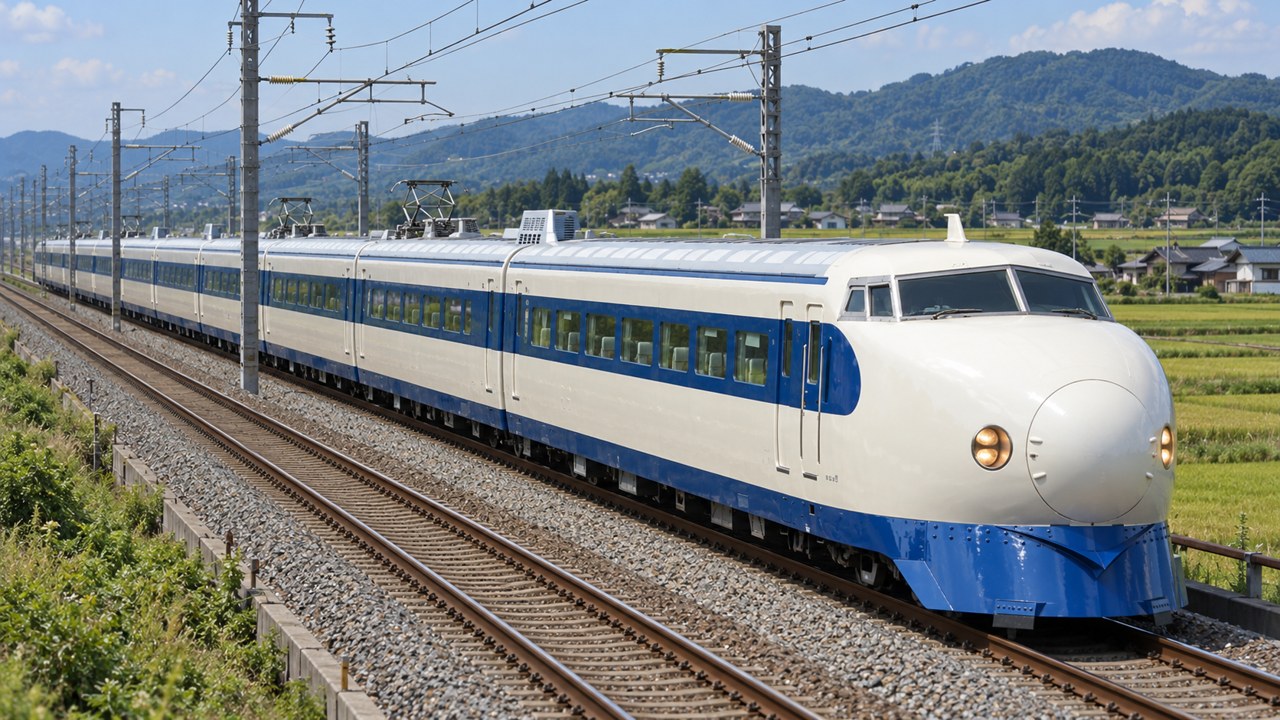
On 1 October 1964, nine days before the Tokyo Olympics opened, the Tokaido Shinkansen began operating. Series 0 trains, with their distinctive rounded fronts, gave this new chapter in railway history a recognisable face.
A practical need lay behind the project. Growing demand had filled the conventional line between Tokyo and Osaka, where express services shared space with local passenger and freight trains. A new line offered additional capacity and the opportunity to organise a different kind of service.
The transformation could be measured on a clock. At opening, the new connection reduced the Tokyo–Osaka journey from six and a half hours to four. Later, the journey fell to three hours and ten minutes. Consider the value of those recovered hours, whether for someone taking an annual trip or a passenger who travelled frequently.
Speed depended on the whole system. Tracks reserved for high-speed passenger services, the absence of level crossings and automatic speed control were elements of a railway in which trains and infrastructure had to work together.
Leading car 21-1, preserved at Kyoto Railway Museum, was built by Nippon Sharyo in 1964. It provides a physical link to that first generation. Looking at it gives a concrete shape to a change that went beyond appearance: bringing cities closer in people’s experience, even when the distance between them remained the same.