United Kingdom / France / Belgium, 1994
Eurostar: Three Capitals, One Journey Beneath the Sea
 ▶ Play timeline ▶ Watch on YouTube ↗
Leaving London and stepping off the same train in Paris or Brussels changed how travellers could imagine a journey to continental Europe. The English Channel was still there, but the route could now continue beneath it. Eurostar turned that railway connection into an everyday experience for its passengers.
Services began on 14 November 1994. In London, trains departed from Waterloo International, a terminal built to receive them. Its sweeping glass-and-steel roof marked the arrival of a service directly linking the British, French and Belgian capitals. Waterloo remained Eurostar's London gateway until 2007, when services moved to St Pancras.
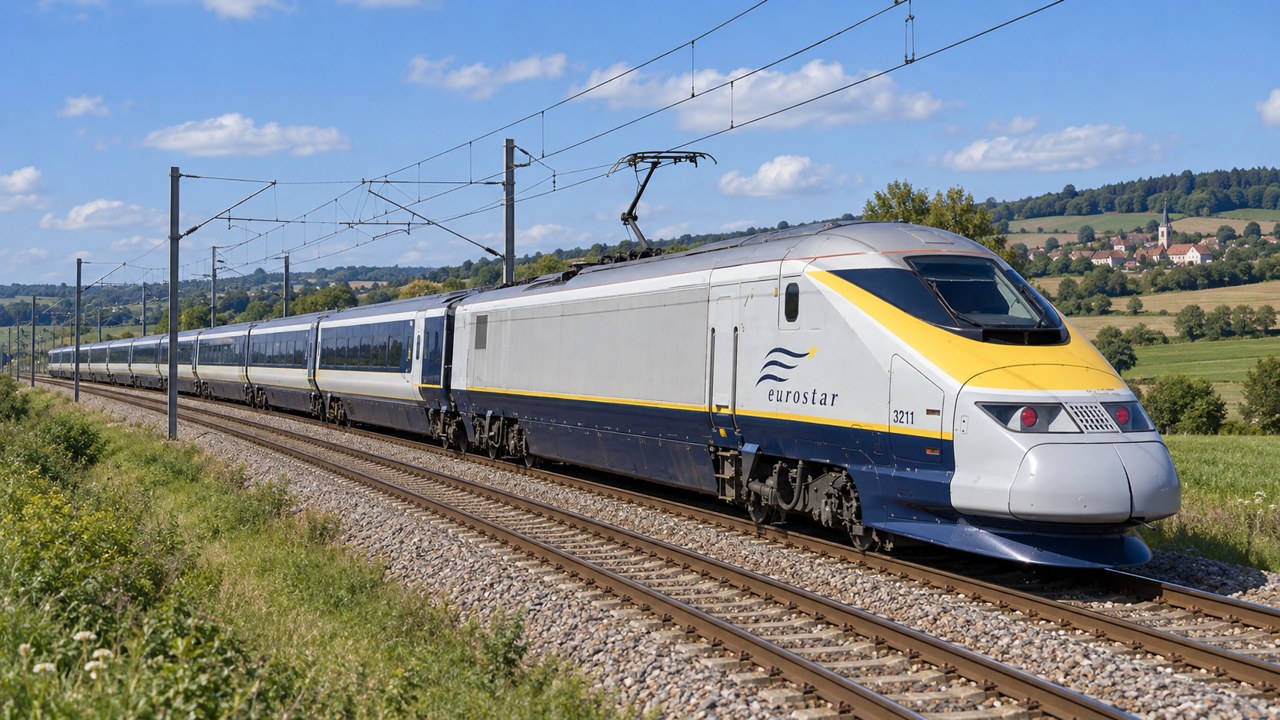
The first generation was known as Class 373 or TMST, short for Trans Manche Super Train. The full-length formations measured roughly four hundred metres and could reach three hundred kilometres per hour. Their engineering had to solve a challenge as important as speed: travelling between countries with different electrical supplies and signalling systems. For a passenger it was one journey; for the train it was a succession of networks requiring compatibility.
Beneath the Channel lay an equally distinctive piece of infrastructure. The link is about fifty kilometres long and comprises two railway tunnels, each carrying one track, and a central service tunnel. The latter provides access for maintenance and emergencies. Passenger services depended on this network of passages beneath the seabed as well as on the trains themselves.
Eurostar shared the link with freight trains and vehicle-carrying shuttles. Its role was to carry passengers between cities: board at one station and continue to another capital without changing trains to cross the Channel.
The journey improved as the infrastructure developed. Opening the first section of Britain's high-speed railway towards the tunnel in September 2003 reduced travel times. The project progressed in stages: the passage beneath the sea was crucial, and the land routes on either side also shaped what the service could offer.
The original Eurostar became associated with crossing a frontier while seated beside a train window. Its significance lay in bringing together, within a single itinerary, cities whose stations had been separated by the sea for generations.