United States · 1934
Pioneer Zephyr: An Entire Train Shaped for the Future
 ▶ Play timeline ▶ Watch on YouTube ↗
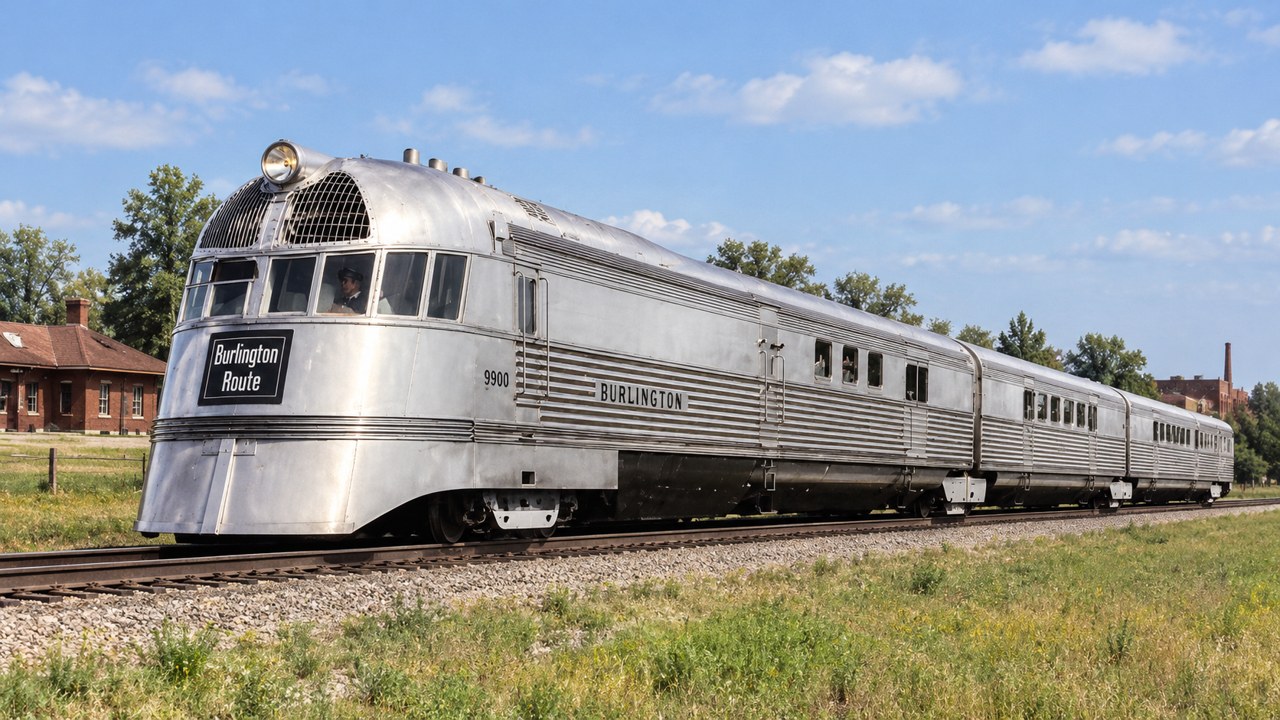
On 26 May 1934, the Zephyr ran nonstop from Denver to Chicago in thirteen hours and five minutes. The demonstration introduced a train combining several innovations in one striking image: stainless steel, a continuous streamlined shape and diesel-electric power.
Built by Budd for the Burlington, the original articulated set contained three cars. Rather than attaching conventional coaches to a separate locomotive, its designers treated the train as a unit. Exterior shape and mechanical arrangement worked together to reduce weight and resistance.
A diesel engine drove a generator supplying electric traction motors. It required neither a steam boiler nor overhead power along the whole route. That independence was particularly attractive on a network of long distances.
Stainless steel gave the train a bright, modern appearance. Its visual impact also served a commercial purpose: railways wanted to attract passengers and make train travel desirable again. Technology needed to work and appeal to the people choosing a journey.
The train later became Pioneer Zephyr as the Zephyr family expanded. Preserved in Chicago after its working career, it represents the combination of design, materials and propulsion in a coherent whole. The future it suggested was more than a different locomotive; it was a different way to conceive the entire train.